01
Context
Reachmind’s existing website presented an operational Context Engine. The business needed a site that explained technical consulting and implementation, while preserving the useful workflow and control methodology.
02
Problem
The primary navigation used product categories. Desktop sections intercepted scrolling and held calls to action behind a narrative sequence. Contact depended on Calendly and email instructions. The repository had no intake storage or notification implementation.
03
Constraints
Keep the existing Next.js and Vercel delivery path. Preserve useful inbound URLs and brand assets. Publish only supportable claims. Do not use credentials committed in an environment file, or connect an unapproved submission system.
04
Reachmind’s role
This is Reachmind’s internal website project, not a client engagement. The work covers positioning, information architecture, interface implementation, intake design, and technical release preparation.
05
Architecture
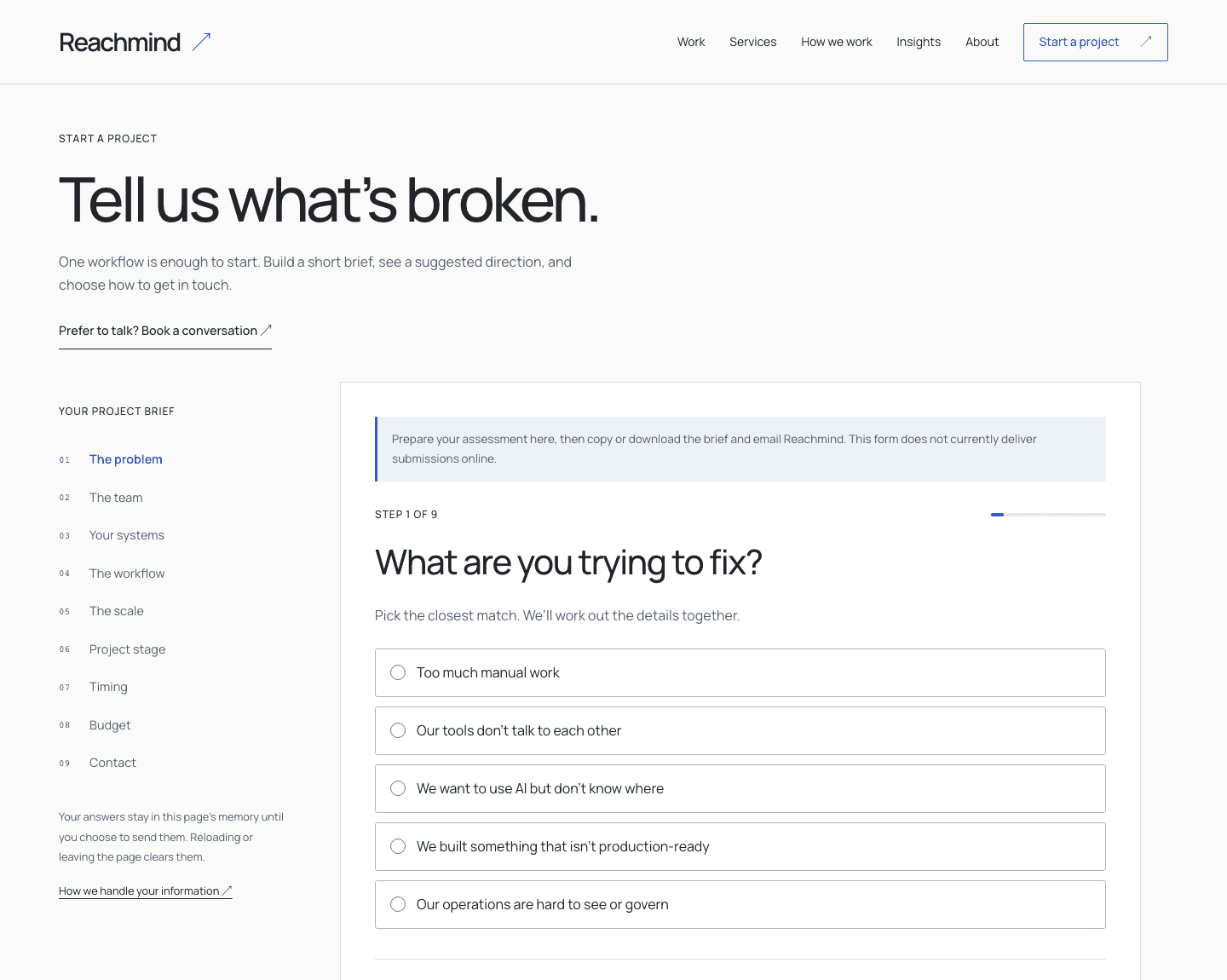
Static server-rendered content carries the main buyer journey. Small client components handle the problem selector and intake. Shared validation and deterministic classification keep the assessment consistent. A server-side submission boundary separates the interface from a future authorized durable store.
- Visitor describes the problem
- Shared rules validate the answers
- A local assessment suggests a starting point
- Visitor copies or downloads the brief
- Visitor chooses to email Reachmind
Direct online delivery is a separate, unconfigured adapter.
06
Implementation
The site introduces clear service sections, methodology, work examples, original insights, and a nine-step project brief. It removes scroll interception, gives each page its own canonical URL, and preserves legacy paths through redirects. The tracked environment file is removed from the current source tree.
07
Before / after
Before: visitors learned a product vocabulary and scheduled or emailed from instructions. After: visitors can identify a problem, understand the relevant engineering work, and prepare a structured brief with a transparent assessment and an email handoff.
08
Outcome
The resulting deliverables are the redesigned website, project intake, shared validation, submission interface, route migration, and audit and handoff documentation. No conversion, revenue, or client impact is claimed.
09
What changed operationally
The initial project conversation now has a consistent structure: problem, team, tools, current workflow, scale, stage, timing, budget, and contact. The interface distinguishes a locally prepared brief from a durably accepted submission.
10
Client ownership / handoff
The source and operating documentation remain in Reachmind’s repository. The owner retains control of hosting, integrations, analytics, and credentials. Direct intake delivery remains an explicit owner configuration decision.
Next phase
Connect an approved intake store and notification provider. Measure the live buyer journey only after analytics is configured and visitors consent.